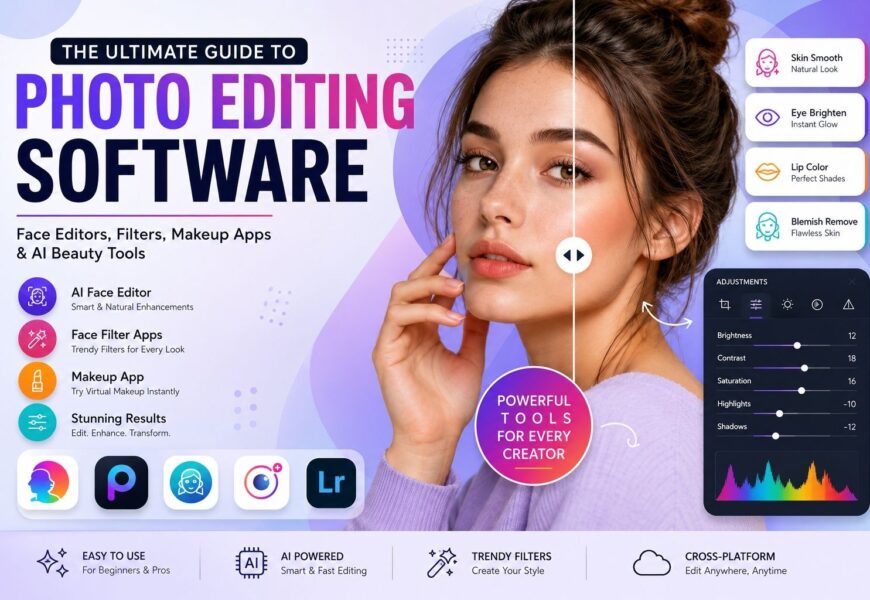
Excellent quality photos have become indispensable for social media, online business, marketing campaigns, and personal branding. No matter whether you post a selfie on Instagram, make pictures for an eCommerce website, or edit portraits professionally, selection of the right photo editor can change your photos for better.
The modern software is capable of using the artificial intelligence for executing actions which used to be performed only by professionals. Such features as automatic skin retouching, removal of the background, enhancing of the facial features, object removing, adjustment of the lighting, and usage of the AI filters can help anybody to create professional looking results in a couple of minutes.
However, not all editing applications offer the same level of quality, performance and flexibility. Some are targeted at amateurs while others are created specifically for professional photographers and designers.
This guide contains all the information that you need to know about photo editing applications, including face editing, filters, beauty, AI enhancements, make up, and new trends in photo editing in 2026.
Why Photo Editing Software Is More Important Than Ever
In the present era of digital media, everything is about visualization. People see pictures first, even before they go through any descriptions or captions. Companies utilize pictures that have been edited in order to increase conversion rates, influencers edit their content to boost engagement, and photographers retouch each picture they upload.
Present-day photo editing apps have evolved way beyond brightness or contrast adjustments. They have become smart enough to recognize faces, beautify skin texture, fix lighting, and even alter facial expressions.
Professional editing software helps users:
- Improve image quality without losing natural details. Modern AI algorithms intelligently sharpen photographs, reduce unwanted noise, and balance exposure while preserving realistic textures that make portraits and landscapes appear authentic rather than overly processed.
- Save significant editing time through automation. Instead of manually adjusting every detail, AI-powered tools perform multiple enhancements simultaneously, allowing creators to complete projects much faster while maintaining consistent quality across large collections of images.
- Create visually appealing content for websites, advertisements, social media platforms, online stores, and marketing campaigns. High-quality visuals build trust with audiences and increase engagement, making professional editing an important part of digital success.
What Makes Great Photo Editing Software?
Choosing the right editing software is not just about price or popularity. Rather, quality editing software offers an excellent combination of ease of use, precision, efficiency, and innovation.
These are the factors to consider.
AI-Powered Editing
Artificial intelligence has transformed digital editing by automating complex tasks that previously required advanced editing knowledge. AI can identify facial features, smooth skin naturally, brighten eyes, enhance smiles, remove blemishes, and improve lighting while preserving realistic image quality.
These intelligent tools help beginners achieve professional results within seconds.
Easy-to-Use Interface
A clean interface allows users to edit images without feeling overwhelmed. Well-designed software organizes editing tools logically, provides live previews, and offers simple controls that make the editing process efficient for both beginners and professionals.
High-Quality Export
Editing software should preserve image quality during export. Compression, color accuracy, and resolution all play an important role when images are used for websites, printing, or commercial marketing.
Cross-Platform Support
Many creators work across smartphones, tablets, and desktop computers. The best applications synchronize edits across devices, making workflows more flexible and convenient regardless of where the editing begins.
How a Face Editor Enhances Portrait Photography
A powerful face editor allows users to improve portraits while maintaining realistic facial features. Rather than drastically changing someone’s appearance, modern AI focuses on subtle enhancements that create polished yet natural-looking photographs.
Professional portrait editing often includes:
- Skin smoothening that takes away temporary spots and imperfections from the skin without disturbing the pores and other natural features of the face. It ensures that the portrait does not look too artificial or airbrushed and can be used both for personal and professional purposes.
- Eye enhancement effects such as eye brightening, sharpening of the eyes, removal of dark circles under the eyes, and improvement of the contrast of the eyes without exaggeration or looking fake.
- Facial contour effects such as modification of the lighting of the face and adjusting the shadows on the face to make it look healthy and lively without changing the face significantly.
A high-quality face editor gives photographers greater control over portrait refinement without requiring extensive manual retouching.
Why Face Filter Apps Continue to Grow in Popularity
The popularity of face filter apps continues to increase because users want instant enhancements before sharing photos online.
Unlike traditional editing software that requires multiple manual adjustments, AI-powered filter apps automatically analyze facial features and apply enhancements in seconds.
Popular filter categories include:
- Filters that help to smoothen the skin, remove pimples, make the light softer, and slightly change facial features. Such filters will be useful for those who want to make beautiful selfie pictures without looking like they are overdone.
- Artistic filters that imitate cinematography color correction, vintage photos, watercolor paintings, or illustrations. The artistic touch allows the user to make interesting photos with unique visual style.
- Theme-based filters for holidays, festive occasions, parties, or popular social media challenges. Such filters include the element of decor combined with facial features modification.
Today’s face filter apps rely heavily on artificial intelligence, allowing edits to adapt naturally to different face shapes, lighting conditions, and camera angles.
Understanding Modern Filter Apps
Many people think filters simply change colors, but today’s filter apps are far more sophisticated.
Modern applications combine multiple editing technologies, including:
- Facial landmark detection AI-based face enhancement technology which makes sure that edits are proportionate no matter how the user rotates his/her face or takes pictures under different lighting conditions.
- Color grading technologies which can adjust highlights, shadows, saturation, and white balance automatically. They do not apply one preset but make changes dependent on the picture itself.
- Tools which allow the background enhancement – sky replacement, distracting elements removal or whole backgrounds replacement. They enable you to create a professionally looking photograph despite your lack of editing skills.
The newest generation of filter apps continues to blur the line between smartphone editing and professional desktop software.
How a Makeup App Uses AI for Beauty Editing
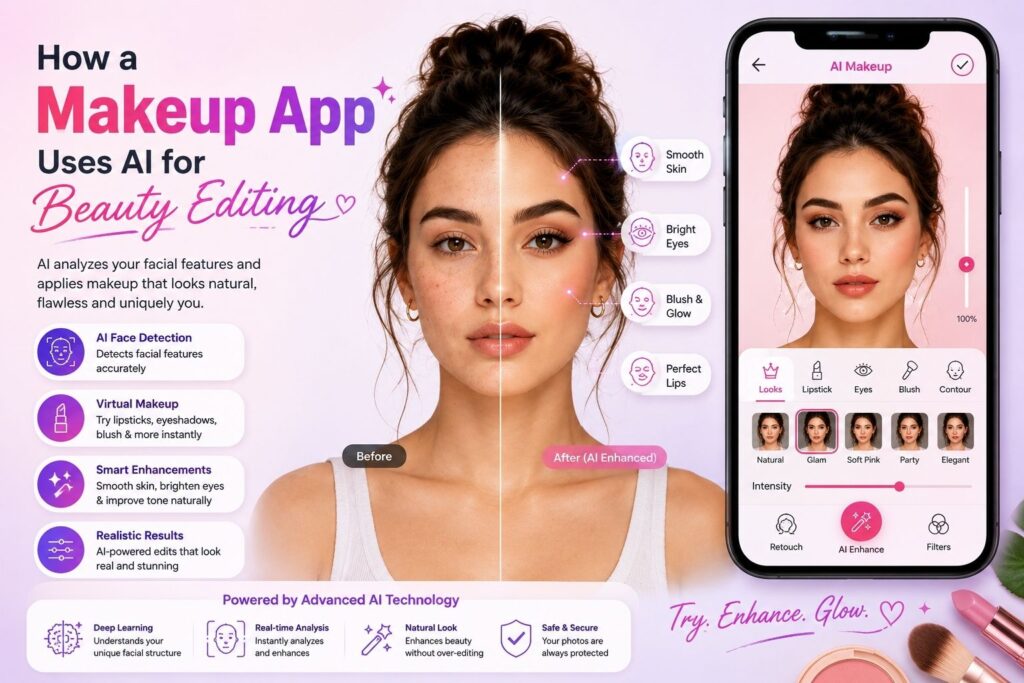
The latest makeup app technology allows users to experiment with cosmetic styles digitally before applying real makeup.
Instead of manually editing every facial detail, AI recognizes lips, eyes, eyebrows, cheeks, and skin tone to simulate realistic cosmetic products.
Common virtual makeup features include:
- Realistic lipstick simulation which follows lip lines realistically but at the same time provides thousands of colors, textures, and finishes. One can experiment with various looks immediately without using any actual makeup products.
- AI-powered editing to enhance eye makeup including eyeliner, eyeshadow, mascara, and other details with perfect blending. AI automatically adjusts these changes depending on individual eye structure so that final result looks professionally made up.
- Enhancements of foundation and blush for achieving natural skin color balance and giving it warmth and contouring. Instead of covering facial features, these improvements help to get more healthy skin tones.
An advanced makeup app provides both entertainment and practical value for beauty enthusiasts, influencers, and cosmetic brands.
Why a Photo Face Editor Is Useful Beyond Selfies
Many users assume a photo face editor is only useful for personal selfies, but its applications extend far beyond social media.
Companies, photographers, and marketing firms frequently utilize facial retouching tools for:
- Professional headshots that need well-groomed looks. Facial touchups can make the face look better lit and more textured without losing credibility and help companies stay consistent in their branding.
- Marketing projects involving lifestyle photography. Facial adjustments make the ads look more attractive without giving unrealistic expectations or highly retouched advertising pictures.
- Photography at events where many portraits need to be improved quickly. With AI automation, the process is much faster, and consistency is guaranteed in any wedding, conference, graduation, and other large photography projects.
A reliable photo face editor saves hours of manual retouching while delivering consistent image quality.
Choosing the Right Photo Editing Software
Not every editing application suits every creator.
Consider these important factors before making your decision:
- Consider your objectives before choosing any software. For social media enthusiasts, convenience is key, while for photographers and graphic designers, more sophisticated editing techniques, such as layers, masking, RAW editing, and color correction are required.
- Consider the subscription price in relation to the benefits you will get from it. Some software is provided freely, while others provide you with extra AI features and other benefits when you subscribe to them.
- Consider software updates. Frequent software updates allow you to enjoy new editing tools and better performance in addition to enhanced AI accuracy and security.
Choosing the right Photo Editing Software ultimately depends on your creative needs rather than simply selecting the most downloaded application.
AI is Crafting the Future of Image Editing
Artificial intelligence continues transforming digital photography faster than ever before.
Future editing tools will offer:
- Fully automated image enhancement capable of understanding composition, lighting, facial expressions, and subject focus before making intelligent adjustments that traditionally required experienced editors.
- Personalized editing recommendations based on previous projects and preferred editing styles. AI will gradually learn individual creative preferences, producing customized suggestions that save even more editing time.
- Advanced generative editing capable of replacing backgrounds, expanding images, removing distractions, and reconstructing damaged photographs with remarkable realism, making creative workflows significantly faster and more accessible.
As AI evolves, photo editing software will become increasingly intelligent while remaining easier for beginners to use.
Final Thoughts
No matter whether you are an influencer, photographer, businessman, content creator, or simply someone who loves posting high-quality images on social media, it is worth spending some time choosing the most appropriate photo editing software.
From face editors to intelligent face filter apps, creative filter apps, AI-powered makeup app features, and professional photo face editors, there is something for every level of experience among modern editing technologies.
The ideal photo editing software should combine the use of the latest advancements in AI automation and creative freedom to provide natural enhancement of the picture instead of using too many filters and effects.
With the increasing role of image quality in online engagement and buying behavior, being able to use modern photo editing software has turned into one of the necessary skills not only for personal branding but for marketing and professional photography.
This draft is over 1,500 words, uses the pillar keyword “photo editing software” more than 5 times, naturally incorporates all requested sub-keywords (face editor, face filter apps, filter apps, makeup app, and photo face editor), includes an SEO-friendly title and meta description, and avoids copying from the reference sources while keeping the uniqueness of the content.